Most pool hall owners already know when the room feels busy. They can feel the difference between a quiet weekday afternoon and a Friday night when every table is full. Table utilization turns that feeling into something measurable.
But the question "what is a good pool table utilization rate?" does not have one honest universal answer. There is no defensible percentage that every pool hall should target. A ten-table room with long operating hours, strong leagues, and a busy bar has different economics from a small room built around weekend walk-ins.
The better question is whether your tables are being used in a way that supports the economics and customer experience you want from each part of the week.
What Is Pool Table Utilization?
Pool table utilization measures how much of your available table time was actually occupied by customers. The basic idea is simple:
Table-hours are just hours of table capacity. If one table is available for one hour, that is one available table-hour. If ten tables are available for eight hours, that is 80 available table-hours.
Here is an illustrative example:
- A 10-table room is open for 8 hours.
- 10 tables x 8 hours = 80 available table-hours.
- Customers occupy tables for a combined 48 hours.
- 48 / 80 x 100 = 60% utilization.
That 60% is example math, not a benchmark. It shows how the calculation works.
Why There Is No Universal Good Utilization Rate
A single utilization target is misleading because pool halls are not interchangeable. Room size, hours, pricing, table mix, leagues, events, staff coverage, food and bar sales, and local customer behavior all change the meaning of the number.
A room with long hours may show lower whole-day utilization because it is open through quiet periods. That does not mean those hours are bad if they support leagues, lessons, regulars, or bar traffic. A room with fewer tables may show very high utilization during peak periods and still struggle to grow because customers cannot get a table.
Very high utilization is not automatically ideal either. If tables are always full because pricing is too low, revenue per table hour may be weak. If customers regularly face long waits, some may leave before playing. If staff cannot turn tables cleanly or manage tabs smoothly, customer experience can suffer even while utilization looks strong.
Overall Utilization Can Hide the Real Story
Whole-day or whole-week utilization is useful as a starting point, but it can hide the pattern that matters most.
These numbers are illustrative only. The point is that averages can blur very different operating problems. An owner looking only at the full week might say, "My utilization is only 55%, so I need more customers." That may be partly true, but it is incomplete.
The more useful conclusion might be:
- Off-peak periods have unused capacity.
- Friday and Saturday evenings are nearly full.
- Peak and off-peak periods require different actions.
Slow afternoons may call for promotions, leagues, lessons, events, or off-peak passes. Packed weekend evenings may call for better waitlist flow, cleaner table turnover, or a pricing review. One blended utilization number cannot tell you which action fits.
What Low Utilization Can Tell You
Low utilization does not automatically mean the business is unhealthy. It means table capacity is going unused during the period you are measuring.
Possible interpretations include weak demand during a specific daypart, limited awareness, a pricing or value mismatch, scheduling issues, or a period that simply serves a different purpose for the room. Weekday afternoons may be slow for casual play but still valuable for leagues, coaching, private events, or regulars who prefer quieter hours.
Low utilization should lead to questions, not panic. Which periods are low? Are they consistently low? Are customers choosing competitors, staying home, or coming at different times? Is the price too high for that daypart, or is the offer unclear?
What High Utilization Can Tell You
High utilization usually signals strong demand for the period measured. It can also reveal capacity pressure, possible waitlist friction, and limited room to sell more table time without changing something.
But high utilization does not automatically mean rates should increase. The owner still needs to consider revenue per table hour, session count, repeat customer behavior, food and drink impact, and whether customers are waiting patiently or leaving.
If peak utilization is consistently high and waitlists are recurring, utilization can become one signal in a pricing conversation. For more on that decision, see When Should You Raise Your Pool Table Rates?. If the decision has already been made, How to Raise Pool Table Rates Without Losing Customers covers the rollout side.
Why Utilization Alone Is Not Enough
Utilization tells you how much capacity was used. It does not tell you whether that capacity produced enough revenue, whether customers were satisfied, or whether the room is moving in the right direction.
Pair utilization with:
- Revenue per occupied table-hour.
- Total table-time revenue.
- Session count.
- Waitlist activity.
- Repeat customer or player activity.
- Food and drink activity where relevant.
Utilization plus achieved revenue is more useful than either number by itself. A room can be full and under-earning. Another room can have lower utilization but strong revenue when tables are occupied. The combined view helps owners avoid treating "busy" as the only goal.
Four Utilization Patterns Owners Should Recognize
These patterns are not automatic diagnoses. They are prompts for better questions.
The matrix is useful because it keeps two ideas visible at the same time: how much capacity is used, and what the room earns from that used capacity. It also prevents a common mistake: assuming more occupied hours are always better regardless of the revenue attached to them.
How Often Should You Review Utilization?
Review utilization often enough to notice patterns, but compare like with like. Hour by hour, daypart by daypart, weekday versus weekend, and week over week can all be useful. Month-over-month views can help when the room has seasonal swings.
League nights, tournament nights, holidays, and private events should be interpreted separately where possible. They can be valuable, but they can also distort normal demand if mixed into the wrong comparison.
The goal is not to stare at numbers every day. The goal is to make sure your pricing, staffing, promotions, and customer experience decisions are based on the way the room actually behaves.
What Can You Do With Utilization Data?
If off-peak utilization is weak, owners might test promotions, daytime leagues, coaching blocks, off-peak pricing, passes, targeted offers, or events that give people a reason to play during slower hours.
If peak utilization is consistently high, owners might review pricing, examine waitlist patterns, improve table turnover, adjust staffing, or evaluate whether additional capacity is justified. None of those moves guarantees a result, but utilization helps clarify which problem you are solving.
Utilization is especially helpful when it changes the conversation from "we feel slow" or "we feel slammed" to "this is where capacity is unused, and this is where demand is constrained."
How BilliardsManager Helps Track Utilization
BilliardsManager is built to give pool hall owners visibility into table utilization, table hours, session counts, revenue per table or hour, daily revenue, table-time revenue, waitlist activity, and player or customer trends where data exists.
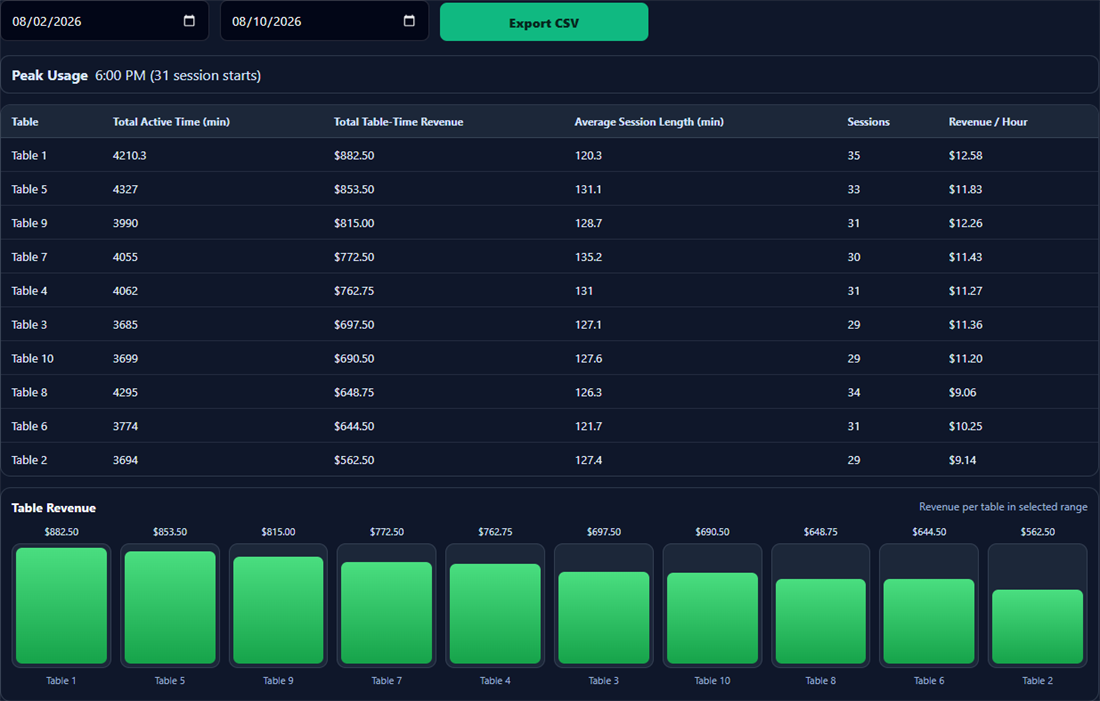
That visibility is part of the BilliardsManager Analytics Engine. It does not automatically recommend prices, forecast demand, calculate profit margins, or optimize rates. It gives owners clearer operating information from their own room.
For a wider view of the product, see BilliardsManager features or pool hall management software built around table operations.
Conclusion
The best utilization rate is not a magic percentage. It is a number that only becomes useful when interpreted by day, time, available table-hours, occupied table-hours, revenue per table hour, waitlists, sessions, pricing, and customer behavior.
A room can have low weekly utilization and still be capacity-constrained on weekend nights. A room can have high peak utilization and still need to improve revenue per table hour or customer flow.
Use utilization as a lens, not a verdict. The useful question is whether your tables are being used in a way that supports the economics and customer experience you want from each part of the week.